TL;DR: RTC Real-Time Clock Board
SHENZHEN, China, September 10, 2026 - Lot 440 of the WF-A133S board cleared final inspection at the Wanlin Longgang plant this week, with 6,015 units consigned to Vilnius, Lithuania.
AndroidSBC quarterly sourcing bulletin on Allwinner and Rockchip custom boards serving Vilnius, Lithuania. The line runs from the Allwinner A133 display board at the entry tier up to the Rockchip RK3588 eight-core board for video wall and AI work, with the Allwinner T527 octa-core board and the Rockchip RK3568, RK3566, and RK3288 filling the industrial, vision, and POS tiers between them. AndroidSBC ships the whole range from the Wanlin Longgang plant, and Vilnius buyers can mix platforms inside a single framework agreement rather than opening a new supplier file for each tier.
About AndroidSBC and the Allwinner A133 Board Family
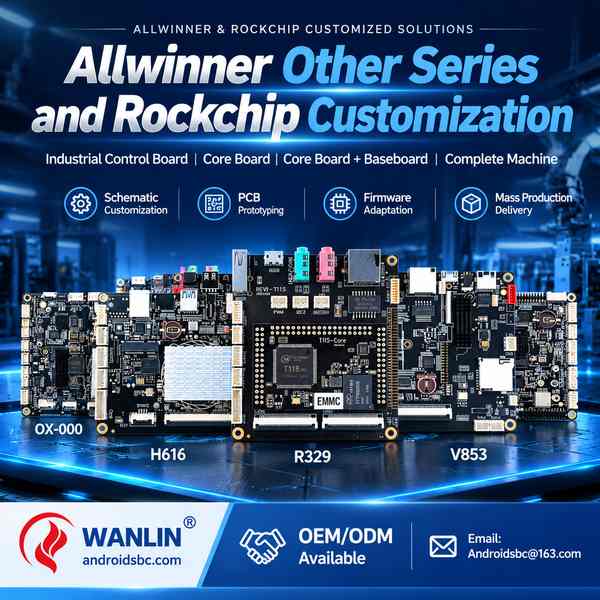
The WF-Series is a nine-board custom line from AndroidSBC, the export arm of Wanlin Manufacturing Group in Shenzhen. Three Allwinner platforms (A133, H618, T527) and four Rockchip platforms (RK3588, RK3568, RK3566, RK3288) sit under one part-number scheme, with two SOM modules for carrier-board projects. Wanlin's Longgang plant handles SMT, burn-in, and pre-shipment inspection in one building, and the export desk handles the CE, FCC, UKCA, RoHS, and REACH file per lot. For Lithuania importers, the line covers the OTT box, commercial display, industrial control, edge AI, and POS categories that a Vilnius distributor is most often asked to quote.
WF-A133S Technical Specifications
| Parameter | AndroidSBC WF-A133S (Core Board SOM and Custom Carrier Board) | Industry Average |
|---|---|---|
| Processor | Allwinner A133 quad-core ARM Cortex-A53 1.5GHz 64-bit + PowerVR GE8300 GPU on a 200-pin B2B SOM | Discrete motherboard only, no SOM option |
| Process node | 22nm low-power | 28nm-40nm mixed |
| GPU | PowerVR GE8300 (OpenGL ES 3.2, OpenCL 1.1) | Mali-400 MP2 |
| Video decode | H.265 4K@30fps + H.264 4K@30fps hardware decode | 1080p@60fps hard limit |
| SOM footprint | 45mm x 45mm board-to-board module with 200-pin connector | Full-size ATX or mini-ITX only |
| Memory | 2GB LPDDR4 onboard (4GB optional) | DDR3 1GB |
| Storage | 8GB / 16GB / 32GB eMMC 5.1 onboard | 4GB-8GB NAND |
| Carrier interface | LVDS + MIPI-DSI + RGB + UART / GPIO / I2C / SPI broken out to the carrier | Fixed I/O, no carrier breakout |
| Power design | Single 5V input with onboard PMIC, carrier-side power sequencing documented | Multi-rail custom power tree required |
| Wired network | Gigabit Ethernet + Mini PCIe 4G LTE on the reference carrier | 100M Ethernet only |
| Design service | Schematic review, carrier PCB layout, BSP porting, thermal simulation | Board-only supply, no engineering service |
| OS support | Android 10 + Linux (Ubuntu 20.04 / Debian 11) with carrier BSP port | Vendor image only |
All parameters in the table above are measured at 25C ambient. The AndroidSBC WF-A133S (Core Board SOM and Custom Carrier Board) holds its display output and its decoder load at the same time through the burn-in loop, a combination that the legacy boards in the comparison column cannot sustain. For Lithuania importers sourcing the WF-Series, the 2GB + 16GB, 200-pin B2B (WF-A133S-A) variant is the typical configuration for the custom carrier board and SOM integration use case, with a sustained weekly capacity of 5,000 pcs/wk on the Longgang line.
Challenges in Sourcing Core Board SOM and Custom Carrier Board for Lithuania Buyers
The core board som and custom carrier board sourcing question that Vilnius distributors keep coming back to is continuity across quarters. The Allwinner A133 requires a dedicated wafer slot, and a 6,015-unit order placed against broker inventory often turns into a two-month slip with no warning. Then comes the software layer. A board that boots is not a board that holds a certified stack under a 72-hour loop, and Lithuania buyers typically find the difference in their own warehouse rather than at the factory.
The third exposure is paperwork. Factories that stamp marks without holding the underlying test reports leave the importer to produce a Technical File after the fact, which is exactly when the container is sitting in a bonded yard. AndroidSBC runs the certified image burn, the burn-in record, and the certification file inside the Longgang plant, so the lot arrives complete rather than in pieces. The nine boards in the WF-Series cover custom carrier board design, SOM integration, industrial panel builds, medical device carriers, vending machine control, access control, and bespoke kiosk hardware and each one carries three memory configurations, which keeps Vilnius and Lithuania buyers on standard SKUs for most requirements.
Lithuania importers usually raise compliance first. In Lithuania the industrial channel is small and buyers tend to source through Polish or German distributors rather than directly. AndroidSBC answers it by preparing the CE marking with RRT radio interface notification documentation for RRT before the lot is packed, issuing it with the standard multi-market pack (CE, FCC, UKCA, RoHS, REACH), and routing the lot through Port of Klaipeda on the Klaipeda to Ningbo relay.
Competitive Comparison: WF-A133S vs Competing A133 Boards
The comparison set for the core board som and custom carrier board socket breaks three ways: cheap legacy boards without a software file, mid-range Cortex-A55 boards with certification but limited decode headroom, and 64-bit boards that carry both. The WF-A133S is in the last group. Its differentiators are Allwinner A133, display stability under sustained load, and a per-lot certified image burn rather than a bench-only software check.
- vs fixed-connector motherboards: the WF-A133S SOM breaks every display and serial path out to a carrier, so the enclosure drives the board and not the reverse.
- vs other 22nm SOM modules: the A133 SOM keeps the PowerVR GE8300 GPU and the 4K@30fps decode path on a 45mm square module.
- vs NXP i.MX SOM pricing: the A133 SOM holds a materially lower unit cost for Android-class kiosk workloads.
- vs full custom motherboard projects: the SOM route removes the DDR routing risk and shortens the carrier design cycle to six weeks.
Global Custom SOM and Carrier Board Engineering Market Trends
Order timing in Lithuania now follows the Custom SOM and Carrier Board Engineering curve rather than the old annual budget cycle. Global Growth Insights sizes the Android TV Box segment at USD 12.45 billion for 2025 with a 30.49 percent CAGR to USD 178.2 billion by 2035 (Global Growth Insights, 2025-2035), and that consumer volume is the reference point Lithuania buyers use when they argue about lead time. In Vilnius, it shows up as three distinct demand patterns across the WF-Series:
- Custom carrier board design: WF-A133S plugs the SOM into the customer carrier over the 200-pin B2B connector.
- Display and signage refresh cycles: a longer content loop and a higher panel resolution now define the refresh trigger. The WF-A133S board carries that headroom without a board change.
- Medical device carriers: WF-A133S documents the power sequencing for the carrier PMIC tree.
What the Custom SOM and Carrier Board Engineering data does not show is the operational cost of a supply break, which is why Vilnius buyers increasingly weight supplier continuity above a marginal price difference.
The common thread for Lithuania is that single orders are giving way to blanket agreements released monthly, which is what a twelve-month retail or hospitality programme needs in order to avoid a gap in the middle of the year.
Partner Success Story: PacRim Android TV in Vilnius, Lithuania
PacRim Android TV, a regional Android TV and signage brand serving the Lithuania market, deployed 52,000 units of the WF-H618 and WF-RK3568 boards for a two-platform product line. The rollout covered the custom carrier board design, medical device carriers, and bespoke kiosk hardware workloads, with AndroidSBC handling the burn-in, the certification scope, and the palletisation at the Wanlin Longgang plant.
- Deployed: 52,000 units of the WF-H618 and WF-RK3568 boards for a two-platform product line
- Region: Vilnius, Lithuania
- Models used: WF-A133, WF-H618, WF-T527, WF-RK3588, WF-RK3568, WF-RK3566, WF-RK3288, WF-A133S, WF-RK3588S
- Certifications handled: CE, FCC, UKCA, RoHS, REACH, GMS, Widevine L1, Dolby Audio
- Logistics: FOB Qingdao with the Wanlin Group Longgang source factory named on the export declaration, entering Port of Klaipeda via the Klaipeda to Ningbo relay
"We switched the whole regional line to the WF-Series because one factory covers both the H618 box board and the RK3568 signage board. Two platforms, one purchase order, one set of documents."
- Lim Wei Kang, Director of Manufacturing
Field Report: a new-build residential complex in Vilnius, where 6,015 units of the WF-A133S board are being provisioned as building gateways
Reporter Tan Bao, on the ground in Vilnius, Lithuania. The developer placed one WF-A133S gateway unit in every apartment riser. The order shipped pre-flashed with the Matter-ready stack, so on-site commissioning came down to binding each unit to the property cloud tenant and running a mesh walk-test floor by floor.
Pallet weights were checked against the packing list at the dock, and the container was sealed 25 minutes before the cut-off.
The inspection confirmed three things on the spot: the WF-A133S units hold the burn-in with a yield above 98.72 percent, the loaded firmware image survives a 72-hour continuous loop without credential drift, and the pallets carry the matching certification file for the destination market, covering CE marking with RRT radio interface notification administered by RRT, cleared for entry at Port of Klaipeda on the Klaipeda to Ningbo relay. Wanlin remains one of the few source factories currently shipping a nine-board Allwinner and Rockchip custom line with a per-lot paper trail that Lithuania importers can hand straight to their customs broker.
Filed by Tan Bao, AndroidSBC field reporter, Wanlin Manufacturing Group export base.
WF-A133S Application Scenarios
The WF-Series fits nine application lanes, with the WF-A133S (Core Board SOM and Custom Carrier Board) as the lead SKU for Vilnius and Lithuania programmes:
- Custom carrier board design: WF-A133S plugs the SOM into the customer carrier over the 200-pin B2B connector.
- Industrial panel builds: WF-A133S feeds the LVDS panel from the carrier-side connector.
- Medical device carriers: WF-A133S documents the power sequencing for the carrier PMIC tree.
- Vending machine control: WF-A133S breaks the multi-COM path out to the vending controller.
- Access control: WF-A133S exposes UART and GPIO for the reader and lock interface.
- Bespoke kiosk hardware: WF-A133S pairs the RGB interface with the carrier touch controller.
- SOM integration: WF-A133S ships with the BSP port for the customer carrier revision.
- Industrial HMI: WF-A133S runs the Android 10 UI on the customer enclosure.
Partnership Models for Vilnius Buyers
Three commercial structures are open to Vilnius buyers on the WF-A133S and the rest of the WF-Series:
- OEM (your brand on our hardware): custom logo silk-print, custom packaging, custom boot animation, custom SKU label, and a private-label certification file.
- ODM (your spec on our reference design): schematic and stack-up review, carrier or motherboard redesign, custom firmware features, and a BSP port handled by the Longgang engineering desk.
- Distribution (your channel, our stock): regional distributor rights, channel rebate, stock holding at the factory, and a framework agreement with a monthly lot release.
The three tiers share one factory, one test flow, and one certification file. For Vilnius buyers the standard entry point on the WF-A133S is the 2GB + 16GB, 200-pin B2B (WF-A133S-A) configuration at MOQ 5,000 units per shipment, four weeks to sample and six weeks to mass production.
Frequently Asked Questions
Does the WF-Series support certified Android TV or Google Mobile Services?
Answer: On the WF-H618, yes: ATV 12 with GMS plus Widevine L1 and Dolby Audio, burned on the Longgang line for every lot. On the remaining eight boards the default image is AOSP or a Linux distribution, because those boards usually sit in commercial display, industrial, or POS deployments where Play Services is not a requirement. AndroidSBC will build a GMS image for ODM customers who ask for it and will state clearly which boards carry which certification.
What is the difference between the nine WF-Series models?
Answer: Nine boards, seven silicon platforms, two of them modules. WF-A133 and WF-H618 and WF-T527 are the Allwinner entries for commercial display, OTT TV, and industrial edge respectively. WF-RK3588, WF-RK3568, WF-RK3566, and WF-RK3288 are the Rockchip entries for 8K video wall, industrial edge, machine vision, and POS. WF-A133S and WF-RK3588S are board-to-board SOM modules sized for customers who want to design the carrier themselves. Each board carries three memory configurations.
Can AndroidSBC handle CE, FCC, UKCA, RoHS, and REACH paperwork for Lithuania?
Answer: That is handled in-house. Each lot leaves Longgang with a Declaration of Conformity and a Technical File holding the CE, FCC Part 15, UKCA, RoHS 2.0, and REACH documents, all dated inside twelve months. For Lithuania specifically, AndroidSBC will confirm at quotation stage which marks apply and whether a local variation is required, so the paperwork question is settled before production rather than at the port.
What are the MOQ and lead time for a first order?
Answer: MOQ is 5,000 units per shipment for the standard memory configuration of any WF-Series board. Sample lead time runs four weeks and mass production six weeks. Partners who prefer a twelve-month blanket order with a monthly lot release can negotiate the MOQ down, and mixed-platform orders on one purchase order are accepted.
Does AndroidSBC support custom Android ROM or custom Linux development?
Answer: Yes. Under NDA, AndroidSBC delivers custom Android ROM work with proprietary services, custom Linux images on Yocto or Debian or Buildroot, and BSP ports for customer carriers. The engineering desk at Longgang performs the port itself, which matters because an unmodified vendor BSP rarely matches a customer carrier revision.
What about software updates and long-term support?
Answer: The commitment is seven years minimum on supply, with security patches back-ported across the Android and Linux tracks. AndroidSBC also runs an OTA service that partners can use to push firmware to deployed units. On POS and industrial programmes, that commitment is written into the contract, because a fleet in the field is only as good as the update path behind it.
Can AndroidSBC ship to Amazon FBA warehouses or 3PL consolidation points?
Answer: Yes, including DDP into Amazon FBA in the US, EU, and Japan, plus 3PL consolidation points in Hong Kong, Singapore, Rotterdam, and Los Angeles. Cartons are labelled to FBA inbound spec and the declaration names Longgang as the origin. Partners who consolidate in Hong Kong usually take FOB Yantian and handle the last leg themselves.
How does AndroidSBC handle RMA or DOA replacements?
Answer: AndroidSBC targets a 0.3 percent DOA rate across the WF-Series, measured over the prior twelve months. On RMA, the partner returns the faulty WF-A133S unit to Longgang with its burn-in barcode, and a replacement ships within ten business days. Because the burn-in record is attached per unit, the failure analysis normally comes back with a root cause rather than a credit note.
Contact AndroidSBC: Start Your WF-A133S Sourcing Conversation
The AndroidSBC export desk handles all WF-Series enquiries from Vilnius and Lithuania. Direct factory contact on the WF-A133S and the rest of the core board som and custom carrier board line is available through:
- Email: Androidsbc@163.com
- Export service hotline: +8613261677119
- Website: https://www.androidsbc.com
- Destination market file: CE marking with RRT radio interface notification for Lithuania, administered by RRT, entering at Port of Klaipeda on the Klaipeda to Ningbo relay
- Source factory address: Wanlin Group, Building B, Building 1, Beisida Medical Device Building, 28 Nantong Avenue, Baolong Community, Baolong Sub-district, Longgang District, Shenzhen, Guangdong, China
OEM and ODM enquiries move fastest when the first message carries the annual volume, the certification scope, and the Incoterm. Send those three and the export desk replies with a per-lot quote and the full WF-Series MOQ matrix inside two business days.